International Policy
Fellowship
Elena Iarskaia-Smirnova
Creating
future together?
Perspectives
of inclusive education in Russia
Research paper
Acknowledgements
I appreciate assistance of my colleagues and mentors,
namely: professor Margareta Bäck-Wiklund from Sweden, professor Pavel
Romanov and Mrs.Ekaterina Timofeeva from Russia, professor Ann Davis from UK,
Dr.Dmitry Zaitsev from Russia, students, graduate students, social workers,
teachers, parents and children, and leaders of NGOs for the disabled, who
participated in my research and provided me with expertise and support, shared
with me own experience, helped to develop research tools and discussed
findings, those who decided to commit themselves to disability and social
policy research and who believes in its necessity and usefulness for the sake
of children, women and men with disabilities.
Summary
The system of education in Russia undergoes deep
changes and the schools experience transformation being influenced by
governmental reforms and market economy. Yet the philosophy of inclusion is shadowed in
public policy agenda. This paper is devoted to the
issues of exclusion and inclusion of persons with disabilities in educational
policies.
In the first section of the paper the key literature
on inequality in education and key concepts of educational policy are
overviewed. In the second section the background and context for inclusion in
Russia is described with the short overview of the history of special education
and with the emphasis on the current legislative conditions for inclusion.
The research findings are discussed in the third
section of the paper, including the concept, method, sample and the results of
the survey, interviews and case studies. This section analyzes peculiarities of hidden
curriculum in a Russian boarding school for children with disabilities, and
discusses the ways how special education constructs the students’ identities. In
particular,
practices of socialization in an educational institution for children with
motor impairments are considered using the qualitative methodology of
ethnographic observation and interviews. This section goes on to analyze the
attitudes of contemporary mainstream school students towards an idea of inclusive
education and considers the case of integration of a disabled child into a
regular school settings.
The final section of the paper contains policy
recommendations and outlines the perspectives for educational
policy analysis.
Literature
and concepts
Analysis of disability in a context of education makes
it possible to problematize social inequality in spite of the fact that since
the Enlightenment, education is considered as a means to achieve equality.
Sociological research into education conducted in the West and in Russia since
1960s have shown that education tends to reproduce social inequality. According
to David Konstantinovski, the myth of equality of opportunities was one of the
most attractive ideological concepts for socialist state, until it has been
challenged by sociologists
(Konstantinovski, 1999: P.5). In 1960-s there was a considerable
breakthrough made by the group of the researchers led by Vladimir Shubkin
(Shubkin et al., 1964), whish demonstrated that Soviet society is not at all
free of inequality in educational system, that it is characterized by the same
processes of status transmission that
any other modern society (Konstantinovski, 1999: 5-6). Soviet sociologists
studied social stratification, mechanisms of social mobility, related to the
system of education (Aitov, 1968; Ikonnikova, 1974; Rutkevitch, Filippov, 1970,
Titma, 1975).
Research conducted in the
United States and Great Britain in 1960-1970s has demonstrated that the social
and family conditions of the student have the biggest impact on the results of
school education, which in turn determines the level of income of a person in
the future (Ashline, Pezzullo, Norris 1966,
Coleman 1966, Jenks 1979). The effectiveness of a learning process is
influenced by the social class of a student, that defines unequal status the
student receives due to his/her house, district, social environment (Giddens,
1999: 398). These research have stimulated a discussion about the necessity of
integrated education of children from difference racial and social groups.
In British sociological research of 1980s the
hypothesis was verified about the factors of social inequality outside the
school. At the same time, new questions have been posed, why schools themselves
are tended to maintain and reproduce inequality (Bloom 1981). However, as the researchers suggested,
improving the quality of teaching, creating a healthy social climate at school
and applied specialization of the school education, will help children from
poor families and children with special educational needs to succeed
academically.
Since the mid-1960s it became clear for the
researchers of education that children with disabilities, especially graduates
of the residential special schools are becoming a part of the least qualified
social-professional groups, being on the low status positions, which do not
require quality education or skills, get low income and have the lowest
prestige (Davis, Moore 1966). Receiving quality education by children with
disabilities is prevented by the multiple structural limitations, that are
characteristic for the societies with the complex stratification structure. The
concept of deprivation related to the poverty, disability and other forms of
low quality of social well-being has become a major term in British and
American research of 1970-1980s. Research in UK in 1970s-1980s led by M.Brown
and N.Madge (Brown & Madge 1982) have demonstrated the difficulties of
definition and finding deprivation that is presented in variety of forms. They
introduced a concept of “multiple deprivation”, that means intersection and
interrelation of factors of unequal access to various social values
A phenomenon of
“transmitted deprivation” was discussed along with the concepts of deprivation
cycle and poverty cycle, which have been invented by Lewis and other US
researchers of so called “poverty culture”. This concept was used to explain a
vicious cycle of socialization into a certain culture and was later criticized
for its stigmatization effects.
A significant influence on
the understanding of inequality of education was made by the work of Pierre
Bourdieu (Bourdieu & Passeron 1977).
According to Bourdieu, education is an instrument of symbolic violence in a
form of classification conflicts, in which the antagonist groups are trying to
impose their own classification schemes as the only legitimate. In this and in
his later works Bourdieu suggests to search for an answer to a classic
sociological question concerning the reproduction of social inequality within
the system of education and in other institutions of culture. The schools and
universities retranslate initially unequal conditions into the different degree
of giftedness; that is why only those with a certain habitus, who possesses the
necessary social and cultural dispositions, can get into the universities being
initially open for all.
An issue of the intellectual
development and ways of its assessment in educational system (Iensen 1977) was
an important focus in the research of inside world of school. In my opinion, as
far as the Russian children with disabilities are studying both in special and
in regular schools, two types of classification conflicts exist: related to
identity formation and to academic achievement. As the teachers feel
responsible for the outcomes of education, while the schools are rated by the
level of academic success, as a result, the attention is paid to the best, to
the most gifted and capable (A review
of the national educational policy, 2000:
15), and children with disabilities become deprived and expelled down to
low levels of the social and academic school hierarchy. In order to study these issue it would be
necessary to refer to the theories of language codes (Bernstein, 1976), organizational anthropology and hidden
curriculum, as well as cultural reproduction (Illich, 1877).
In several countries of the world, starting since
1970s, there is a considerable development in elaboration of legislative acts
and implementation of educational policies concerning the widening of educational
opportunities of persons with disabilities.
Implementation of such acts and other measures is classified as positive
(or reverse) discrimination as a system of privileges which provide equal
opportunities to a group which is otherwise discriminated against in the
society. In order to make the system
of positive discrimination to function, the special measures are taken that are
called affirmative action – measures that promote representatives of minority
through the shortening of privileges of majority. Politicians, scholars and
activists of civil society today discuss a questions of vulnerable population
to quality secondary and higher education.
In recent history of educational policy in the US and
Europe USA several approaches have been developed: desegregation of schools, widening participation, integration, mainstreaming, inclusion. Mainstreaming means that
the learners with disabilities are included in general education classes to
increase their social interaction opportunities but not necessarily to address
their educational goals. Integration
refers to such a strategy when learners with disabilities attend the same
school but not necessarily the same classes. Finally, inclusion means
organization of a school so that all students who would usually be assigned to
it are educated with their age-peers. Inclusion means a continuum of services
that is needed for an individual student.
To clarify the difference between the inclusion and
integration, let us present their features in a table:
|
Inclusion |
Integration |
|
Including someone from the start All children need to be included in the educational
and social life of their neighborhood school All students are provided the supports to be
successful, secure and welcome |
Returning someone back in Meeting needs of certain categories of children Adjusting special needs children to regular school
environment, which basically remains the same |
All the concepts noted above are based on a several
theoretical perspectives: theory of social justice, social systems theory in
regard to human development, social constructionism, information society,
structuralism and social criticism. In regards to the systems theory it is
important to mention the works of U.Bronfenbrenner who has shown that human
development as the process through which growing person acquires a more
extended, differentiated, and valid conception of the environment
(Bronfenbrenner, 1979). It happens so because
children are being involved with greater interest into the more actions and
contacts, changing their social environment. Therefore,
we should not control individuals but help them develop self-management and
decision-making capabilities.
A similar idea was presented by Breme (Breme 1975),
who says that each human being has his/her own curriculum, own rules, and we
cannot participate in any group activity unless we learnt the rules of the
group. Therefore, the students should learn how to survive at a school, while
the teachers should teach them not just academic skills but social and organizational
structure of a school. At the same time, the teachers should remember that the
rules are different outside the school. Therefore, while the conditions of a residential special school
can be as comfortable and nurturing as possible, the students are not adjusted
to the post-school independent life. The nature of a school becomes a
problematic issue for the students with disabilities. In special segregated education we face with a dilemma of helping
children to survive at school while we should constantly help them to develop
skills of self-management, decision making, to develop independent living
skills for adulthood.
A US scholar Jane Mercer has stressed in her research
(Mercer 1971) that each social system gives a person new definitions, therefore,
disability is a result of societal conventions (Mercer, 1970). She has shown on
empirical evidence that many students who were seen incompetent in school were
competent in other social systems.
The legislative acts of 1977 and 1990s in the US have
guaranteed education for all disabled children in the least restricted
environment. In 1962 M.Reynholds introduced (Reynholds 1962), and later E.Deno
developed (Deno 1970) a concept of “cascade of services” which is a continuum
model for service delivery for an individual student from education at a
hospital and home based education to special schools, link classes and finally,
to ordinary classes of regular schools. In the latest case we can talk about
inclusion – a concept which was first introduced by Mrs. Madlene Will an
ex-assistant of the State Secretary of the Department of Education in the US
(Will 1986). Since then a concept of inclusive education is developing and today it is understood as a
commitment to educate each child, to the maximum extent appropriate, in the
school and classroom he or she would otherwise attend. It means bringing the
support services to the child rather than moving the child to the services.
Principles of inclusive education are as follows:
- Various needs of the
disabled students should correspond with a continuum of services,
including such educational environment, which is the least restrictive and
the most inclusive
- Arranging physical and
organizational conditions to accommodate the unique needs of each student
- Providing every student
any services (s)he might need: physical, occupational, or speech therapy,
instruction in Braille, sign language, mobility and orientation training,
computer for communication
- Challenging every
student to go as fast and as far as possible to fulfilling his or her
unique potential
- Developing and
maintaining a positive classroom atmosphere important to learning for all
students
Background
and contemporary context for inclusive education in Russia
Speaking shortly, the Russian history of societal attitudes towards people
with different impairments can be traced back to the middle ages and considered
as including the following stages:
- From aggression and
intolernace (XV-XVI centuries legislation) towards acknowledgment of the
necessity of social care (XVIII c.)
- Discovery of learning
capabilities of deaf and blind children (XVIII c.), individual teaching,
first special education settings (early XIX c.)
- Acknowledgment of the
educational rights of “abnormal” children, establishing institutions of
special education (late XIX c.)
The first institutions where children with impairment
could get education have been developed under the support of church and
philanthropies. In Soviet Russia special education became a responsibility of
the State. Secularized state system of education and upbringing was developing
under the conditions of inadequate financial resources. There was serious lack of facilities for the
deaf, blind and mentally delayed children. A prominent Russian and Soviet
psychologist Lev Vygotski has developed a theory of social conditioning of
child development: “The development of a defective child is conditioned by a)
the feeling of low social value of oneself, b) the social adjustment to the
normal conditions of environment” (Vygotski, 1929). Therefore, a disabled child has special needs, which are to be
met to prevent his/her handicap. In
1920s a concept “deficient child” was introduced by Vygotsky and a discipline
“defektologia” was established. In
1930s there was a tren to develop a system of special education to include not
only “deficient” but also “disorganized” children. During economical growth
of 1950-60s a wide network of special residential schools was created in
Soviet Union.
Special education in the late Soviet period may be in short
characterized by the following developments: Children are classified as
“capable and incapable of learning”; a concept “disabled child”
(rebenok-invalid) is introduced in 1979 following the ratification of
international legislation. In the rhetoric of official agenda of the
post-Soviet period there is a recognition of the necessity to move from equal
rights to equal opportunities; from institutionalization to integration
(1990s). During this period the terms “children with special educational needs”,
“children with limited abilities” are discussed; a term “Special education” is
sometimes used instead of “defektologia”.
In Russia today special education is a complex system
of different types of school, vocational colleges and institutions. It includes
kindergartens for children three to six years old, special boarding schools
with ten years of study for children aged seven and above, vocational schools,
with three years of study. There are also nursing homes for children and
adolescents considered “non-educable” due to the diagnosis of severe mental
retardation, as well as psycho-neurological nursing homes for children and
adolescents with diagnosis of severe mental disorder – both these institutions
belong not to the system of education but to the system of labour and social
development.
According to national statistics, there are 1800
thousand (5%) children with different impairments; more
than 500 thousand children with special educational needs who are studying at 1905 special schools including residential schools (some of the students
receive home-based education) or in special classes in regular schools (210
thousand students). Each year about 27 thousand graduates are coming out of
special, correctional and residential schools. Only every 5th of them
enters vocational educational institution for further qualification, and every
10th gets employed.
In Saratov region (2 mln population) there are about
1,5 thousand (1479) schools including 29 special schools (8 types of special
schools) for children with intellectual and physical disabilities. All school students 362 658 (about 600
thousand – incl. vocational schools ‘PTU’), 4206 children with special
educational needs. Comparing to 1999 the number of such students in 2000
increased by 4%. The number of link classes (special classes in mainstream
schools) decreased by 18%. Comparing to 1999 (9,100) by 2000 there were 9,300
thousand disabled children in Saratov region (since 2000 the age for the
definition of ‘child with disability’ is considered 18). The biggest proportion
of the disabled children 59% are 8-14 yrs old, the second big group 21% are
children 4-7 yrs, 59,9% of the disabled children are boys. Among the population
of the disabled children with disabilities 90% are in families.
Does Federal Law favor and/or require
inclusion?
The bill of
Russian Federation “Concerning the education for people with limited abilities
(special education)” which is waiting for its approval by the President of
Russian Federation since 1996 emphasizes the opportunity for disabled children to study in regular schools. The
report of State Board of Russia “Contemporary educational policy” of 2001year
points to the priority of integrated (inclusive) education for disabled children:
“Children with disabilities should be supplied by state medical, psychological
support and special conditions for study, predominantly in secondary schools
according to their living place, with rare exception – in boarding schools”. At
present time integrated education could be considered as the priority of state
educational policy in Russia. The transition to inclusive education is
predetermined by Russia’s ratification of U.N. Convention of children and
disabled rights.
Meanwhile, the majority
of schools, colleges and universities are not ready to meet the entrants with
disabilities: there are no special constructions, special programs designed for
such kind of education. Equal rights and opportunities do not exclude, but on
the contrary, suppose the creation of educational sphere for disabled (personal
tutor, special lifts and elevators in every educational center, special
keyboards for people with visual impairments). Only several institutes of
higher education have centers for study of disabled students.
Modern social policy in the sphere of higher
education is not based upon class principle, but on categorical approach.
Besides, the institutes of higher education have comparative freedom in
admitting the students. The legislation regulates access to higher education
for citizens of Russia and legitimates certain conditions for entering
colleges. It’s confirmed by several documents, first of all by the Education
Act of Russian Federation Education, adopted in June 1992 whish guarantees
conditions for vulnerable social groups regarding their positive
discrimination: “To admit without a competition to the state-based and
municipal institutes of higher education following persons: orphans and
children without guardianship, disabled children, disabled persons of I and II
categories, … children with one parent, children with disabled parents,
discharges, persons from low income families, … war disabled, successfully
passed the entrance examinations and have no counter-indications for studies”.
However, is an issue of quality of secondary education for those social groups
that are listed in the Act.
Research: method and findings
The research design represents a multi-methodological
model and includes three types of studies: ethnographic
case studies (case
study in a residential school for disabled children, case study of a disabled
child in a regular school), series of interviews with school administrators and
officials of the department of education, and survey of three types of social
actors – school students, parents and teachers.
Case study at residential school
In context of social and economic
transformation of the last ten years in Russia a school for children with motor
impairments experience changes but at the same time it reproduces Soviet
stereotypes and educational discourses. This section discusses cultural forms
which support positive identities and friendships but at the same time nurture
patriarchal and disabling structures of communication and socialization. An
inside world and organizational culture of the residential school is observed
with its features of isolation, power hierarchy, social segregation which
contributes to the life style of the disabled. This segregation is reinforced
through a strong social control, not just through manifest discipline and
punishment, but also through the hidden curriculum.
Close and familial relations within the
classroom are joined by a strong social control, lack of privacy at the school
and deficit of parental involvement into their children’s education. The latent goal of this system is to
form such individuals, which can survive on everyday base, who can cope with
daily needs. However, the politics of special education for children with
disabilities marginalize children and limits their social orientations and
perspectives. The liberal democratic vision of education as the vehicle for
individual development and greater social equality does not correspond with
separate school system which develop a problem of educational inequality. The
individuals who are recipients of education cannot be identified as the source
of the problem, rather, the special education system itself demonstrates its
inadequacy with the notion of human rights.
Method
The methodology of this research combines survey, in-depth interviews,
and ethnographical case-studies. Survey has focused on the study of public
attitudes towards inclusive education. Ethnographical case study (Bassey 1999)
helps study an institution in frameworks of a concept of hidden curriculum
that, according to R.M.Hall and B.R.Sandler, is understood as verbal and
non-verbal communication practices in education (Hall, Sandler 1982) and
depicted by M.Stubbs as meta-communication which is a means of social control
(Stubbs 1976). Hidden curriculum includes following elements (Wood 1994): (i)
organizational culture of an institution, (ii) content of subjects, and (iii)
teaching style. These three dimensions of hidden curriculum not just reflect
stereotypes of gender and disability, but also reinforce social inequality by
constructing identities according to symbolic classifications of feminine and
masculine, disabled and able-bodied. The research intends to pragmatic
tradition (Giarelli 1988) trying to influence the widening educational chances
of children with disabilities.
Context and case
A
boarding school in focus of our study includes both elementary and secondary
levels. The school was founded in 1960 as a residential educational facility
for children who were affected by polio disease. That polio epidemic happened
in Russia in early 1950s. Today school accepts children from 7 years old who
have motor impairments of different kinds – mainly the polio and cerebral
palsy. It needs to be stressed, however, that the school building is
inappropriate for special needs so that the children with severe motor
impairments, those in wheel-chairs cannot study here neither they are denied
the access to public activity in a wider context due to the physical barriers,
unadjusted transportation, buildings, toilets and elevators.
Among the students today there are orphans, children
whose parents have lost parental rights, as well as kinds from well-to-do
families. There are two types of groups
in the school: A and B. The ‘A’ group is for children with developmental delays
(intellectual disabilities). The ‘B’ group is for children without intellectual
delays. There may also be cases of speech-language, hearing and visual
impairments. In such cases children will be placed into A or B group according
to their intellectual ability, a diagnosis, which is often questioned by
parents and professionals, so at least one case we discovered when a child has
been transferred from one group to another a few times.
Some
children stay over the weekend, some – overnight several days per week,
others are here only during the day.
The more children stay overnight, the more likely they are coming from lower
income families. The orphans live in the boarding school. Anyway, the
population of students is very diverse in terms of social class. This situation
is unlike the Russian educational system in general where the schools become
more and more differentiated according
to the status of families of the students. In a boarding school the factor of
child’s disability plays more important role than the social status of his or
her parents. At the same time, this does not equate the social chances of
children as the families with higher income invest additional money into home
tutoring and they also use their social capital in getting for their child
access to higher education.
Gender and disability at the school
Hidden curriculum is analyzed in aspects of
organizational structure and culture, content of lessons, and methods of
communication. Gender and disability are embedded into organizational structure
and culture. All teachers except for the principal, electrician and mechanic
all teachers and mentors (mentors work with residents) are female. Authoritarian style of management and
discourse of power contributes to the creating sense of hierarchy, discipline
and military-like institution. We discovered the absence of big mirrors in bedrooms and toilets. The girls bedrooms are
located on the second floor with the class rooms located between them which
contributes to the lack of privacy. The rooms of girls differ from the boys
rooms in that on the girls beds there are toys – one doll or one stuffed animal
to the right high corner (very identically located on each bed).
Following peculiarities of a boarding school
contributes to construction of disability:
·
Medical services are provided at school
comparing to community health services for ordinary children and a minimum of
medical service at mainstream school.
·
Individualised programs comparing to mass
education at a mainstream school.
·
Life skills classes, occupational classes
comparing to a learning such skills in everyday life by an ordinary child,
special physical training (OT) comparing to sport classes at mainstream school.
·
Pre-school class to prepare a child for a
school.
·
Absence of high school group: after graduating
10 years in boarding school, the child should go to vocational school, nursing
home, or if the mainstream school graduation is desired, to the 10th
grade of mainstream school to study for another two years.
·
“Inclusive schooling” in terms of multiple
disabilities in addition to the motor impairments of different levels comparing
to the “monoculturalism” of the mainstream Russian school.
·
The programme is relaxed – one may be out of
school for three months for a hospital and then be back and catch up with the
program in a week.
We
considered symbols which are exposed on the walls inside the buildings: the
rules / principles of the school, sentences of the famous people, medical
prescriptions, boards with hand-made objects. For example, we considered the
“rules of the school” that are the commandments on display on the walls at
every classroom and at the ground floor on the news board.
‘The rules of the school’
1. Do not let yourself
down, keep your dignity
2. If you wish to be respected, learn
to respect others
3. Be kind with the camrades, do not hurt anybody
4. Nurture your patience, learn to protect
yourself
5.
Nurture courage in yourself. If you are guilty – do not
hide yourself behind
the
others
6. With all your forces try
to study and work, and your life in the boarding
school will be interesting
7. Strenghthen your body and character, learn to overcome hardships,
and you'll become a real person
8.Love and care for your boarding school – and it always will help you
The first
principle is based upon the negation– it is assumed that the student will shame
his/her name. A similar commandment could be formulated instead in the
following way: “Be proud of your good deals, achievements. You have human
dignity”. The second principle needs to be compared with the unconditioned
respect of human rights that are inherent to any human being. The third
commandment is written in a masculine gender and again in negative structure
which could have been positively expressed so: “help each other”. The fourth
commandment corresponds with the violent practices existing among the kids.
Parents report about the fights among kids, that are considered as a norm by
the school Principal who, according to our interview with the mother of the
disabled child, at the first meeting asked her daughter not about her skills to
count but about her skills to fight: “it
is necessary to fight because at our school older children often hurt younger
ones”. In the fifth commandment the misbehaviour and dishonesty are
assumed, and the feeling of guilt is imposed on the child. A similar principle
of conduct could be depicted in a simple “be honest”. Interesting life of the
students is limited to studies and work inside the boarding school which in
return demands loyalty from its students; the circle of
support is limited to the boarding school as
well.
The disability is interpreted here as tolerated and
just ordinary identity. Children are taught to live with disability, to adjust
to it. However, this does not
necessarily help to develop highly culturally sensitive and valued social
identities for students (McIntosh 2002). The content of lessons effects the
construction of gendered and dis-abled identity of a student. Gender is learned
through manifest and latent translation of stereotypes during and beyond the
lessons. Science and math classes demonstrate clear tendency to gendered
teacher-student communication. In their classes, teachers of history, Russian
language and social skills use gender-balanced communication model. It appears
at the first glance that the life skills and occupational skills classes are
not gender-specific: both boys and girls in young age are taught to brash their
teeth and to take on clothes, to use post office, to shop, and to cook, to sew
clothes and stuffed toys, with one exception: the girls are not taught
carpentry. However, the occupational skills class is
taught separately for older boys and girls is
conducted separately for girls and boys and by different teachers. It is assumed the girls will go on for vocational school for seamstresses
or training for typing (computer word processing – although such a chance will
be very rare), while the boys will get the training in shoemaking, carpentry,
TV or radio repair. None of the subjects in the boarding school
addresses the issue of disability except for the social skills class that is
focused on vocational choices and practicing everyday occupations such as using
different services at post office, paying bills, etc. However, the importance
of open discussions of disability and gender, sexuality, rights and supportive
networks is obvious as the graduates of this school are not prepared to live in
the society after they have for years been nurtured and fostered by the
institution.
Gender stereotypes are expressed in everyday
communication and in our interviews. According to teachers, the girls must be
obedient, assiduous, accurate, not intellectual: Interviewer: “May we talk to the children concerning the
graduation party?” Respondent: “You’d
better come next week, because now there are only two girls. Boys are more
active, more intelligent, they have more humour. The girls unlikely will
propose you something worthy”; “In her situation, she must be even more
accurate”; “a boy can find somebody
to take care for him, while the girls – they must be clean, neat!”
The
disability discourse is hidden. A teacher never says to a child ‘you are
disabled’. The words ‘disability, disabled’ never sound in this school.
However, disability is being communicated,
taught and learned through micro-practices of everyday life in this
school. For example, although every teacher encourages children to do the job
but their attitude is not a demand: if the children do not prepare homework
(which happens all the time), the teachers do not insist. The level of academic
demand is rather low. As a result the curriculum does not correspond to the
program of mainstream school which makes it very difficult for the student to
catch up if (s)he would like to transfer there in order to continue for higher
education. The standards for education in this school have been even lowered
since previous years according to the teachers who work here for a long time.
In the interview with a female student, 17 years we
see the effect of stigma (Goffman 1986) of disabled identity which is imposed
on children not just by institution and system of special education but also by
the societal attitudes towards disability in Russian society: “What are you saying? An institute? I won’t
be able to go there. Why? Why should I? I sew very good!” Teachers in the
interviews are focused on impossibility or unlikeness of personal lives or
professional careers of children in the future.
While
in education research throughout the world the issues of inclusive education
are debated and the different experiences of inclusion are discussed (Daniels
and Garner 2000; Shevlin et all. 2002), in Russia the majority of children with
disability are taught in segregated schools. Poor developments of special
school system in post-socialist countries has been depicted in international
studies (Moore and Dunn 1999). In context of social and economic transformation
of the last ten years in Russia a school for the children with motor
impairments experience changes but at the same time it reproduces Soviet
stereotypes and educational discourses. The transition from socialism to market
has worsened the conditions of special school system due to significant
decrease in public financing of boarding school, lack of specialists who goes
to special education upon their graduation because of inappropriate salary on
one hand, and because of possibilities to be employed in private sector, on
another.
We
observed cultural forms which support positive identities and friendships but
at the same time nurture patriarchal and disabling structures of communication
and socialization. One cultural form is an inside world and organizational
culture of the boarding school with its features of isolation, power hierarchy,
social segregation which is contributes to the life style of the disabled.
Sometimes this segregation is reinforced through a stronger social control,
through the hidden curriculum. Close and familial relations within the
classroom are joined by a strong social control, lack of privacy at the school
and deficit of parental involvement into their children’s education. While
classroom babysits, the school polices (Hurst 1991: 187), and the separation of the family from the
classroom and school reflects wider processes of isolating the disabled from
the society. Another
cultural form which is reproduced among the students: the difference in social
class, urban/rural background, presence or absence of a family, different plans
for the career. It is likely that such differences effect children’s conflicts.
Conflicts exist between parents and teachers, teachers and children, among the
teachers as well as violent relations among the children.
Peculiarities of special education have both
positive and negative effects on children. As it is seen at the boarding
school, centralization of services – educational and medical services at one
place – means cost-effectiveness for the state, as well as time and energy
savings for children and parents. At the same time it leads to medicalization
of special education (Bart 1984), and all problems in children’s academic
development are considered from the point of view of medical experts who have a
big power here. Physical environment at the school which we studied is not
adjusted to the needs of children with severe motor impairments and they are getting
home-based educational services. Comparing to mainstream school the number of
students is less, boarding school it is not overcrowded which decreases the
risks of trauma. Besides, student-staff ratio here provides much more
possibilities for individualized teacher-student interactions. The boarding
school has a special curriculum – it is individualized, adjusted to the needs
of every child but at the same time the paternalistic attitude towards children
with disabilities leads to the low demands on the academic side of the school
program while the everyday skills and occupational skills are also taught
insufficiently. Social interactions are limited here to the contacts among the
disabled children and their tutors and teachers; friendships with non-disabled
peers are very rare cases. The teachers report, the children from surrounded
houses do not come to play together with residents due to the recent decline in
the neighbourhood culture (yard games) in Russia.
The ratification of state standard in professional
rehabilitation of disabled people lies ahead, just as organization of the
retraining and raising the skills level in the conditions of integrated
education. Institutes if higher education must develop their activity to
achieve “barrierless” environment and to create new technologies of education.
However, it will take place only after elaborating the federal conception of
the continuous professional education for disabled persons, its legal support
and recommendation for curricula at those institutes where disabled students
study.
Survey
In March-September of 2002 a survey has been conducted in order to learn about the attitudes of 289 school students, 276 teachers and 260 parents towards an idea of inclusive education.
Parents and teachers have somewhat similar opinion towards the inclusion, although in general parents are more tolerant than the teachers. Answering the question “Is integration possible?”, the parents demonstrated greater positive attitude towards inclusion of children of all types of impairment (Figure 1). The questionnaire for parents in Russian is here.
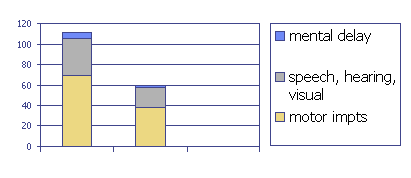
Parents Teachers
Figure
1. Is integration possible? (Parents N=260 and teachers N=276)
We asked both parents and teachers for their personal agreement about inclusion, and about 80% of parents answered positively to a question “Would you personally agree if a child with motor disability would study together with your child?”. At the same time, only 16 % of teachers answered “yes” to the question “Would you personally like to see children with motor impairments in the groups you work with?”, while 32% said “No” and 52% had difficulty to answer this question. It may be explained through the fact that inclusionary policy would obviously affect a teacher’s professional position (Figure 2). The questionnaire for teachers in Russian is here.
Figure
2. How would inclusion affect a teacher’s professional position? (Teachers
N=276)
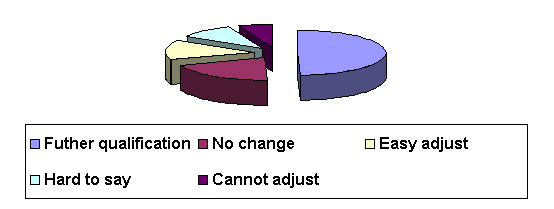
Both
parents and teachers answered similarly to the question “What prevents
inclusion?”, ranking the obstacles from the unadjusted physical environment,
inadequate financing of the schools, to the quality of teaching, lack of
specially adjusted educational programs, social inequality within a society,
and lack of legislative base. Such factors as negative social attitude and parental preferences were
ranked with the lowest scores.
It’s necessary to notice that only a small number of the students never mentioned children with disabilities in our society. Approximately 40% have seen them in the street, 20% have been acquainted without any communications, and 10% have been in touch with them (figure 3). The questionnaire for school students in Russian is here.
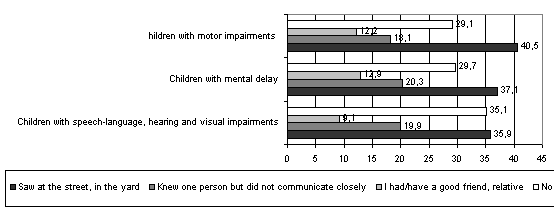
Figure 3. Are there persons with disabilities among
your friends or relatives? (School students N=289)
The
analysis shows that the closest contacts, characterizing the relations between
good friends and relatives, are put into practice among respondents and
children with motor impairments (12,4%) and mental disorder (12,9%). Contacts
between respondents and children with speech, hearing, vision impairments
occurrarely (9,1%). Children with visible
disability are among those who have been seen in the street by our
pupils (40,5%). So, approximately 70% of questioned school students demonstrate
different knowledge of disability’s problem. The fact, that only small
proportion the school students could make the acquaintance with disabled
children, proves its small possibility, which is enclosed by institutional
frames, especially by the structure of educational system.
The
dilemma of segregated special education is two-sided: on the one hand it helps
to combine medical and teaching skills, one the other, it prevents social
integration of disabled children and promote their segregation and limitation
in their life chances. Children and their parents are dissatisfied with this
situation, which is not in accordance with the reformative intentions of the
modern educational system in Russia. But as a whole, one can see the importance
of a new approach to social policy, which replaces the technocratic discourse.
Inclusive education provides the humanistic alternative and allows decreasing
the process of marginalization of disabled children (Iarskaia-Smirnova,
Loshakova 2002).
Inclusive
education during the process of introduction may run into the organizational
difficulties of physical barriers (ramps, one-storied school building, using
the gesture-translators, reconstructing of public places), and with such social
obstacles as stereotypes and prejudices, refusal to admit differing children
into the group of peers.
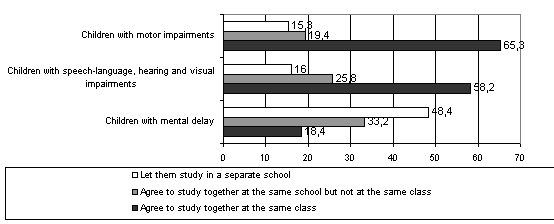
Figure 4 . What do you think of integration with
disabled children in same school? (N=289)
As we
can see, the school students feel the most tolerance towards children with
motor impairments, less – to children with speech, hearing and vision
impairments. The lowest level of tolerance is concerned children with mental
delay – almost half of the pupils wish them to study separately, at another
school. It’s evident, that in this case we are dealing with deeply rooted
stereotype, stigma of mental retardation, which forms serious barriers for
integration of these children and adults to the society. The distribution of
the answers to the question about possibility of communication with disabled
children points to this fact. There are groups with the negative attitude
towards disability (up to 5,9%) regarding children with motor activity, speech,
hearing, vision impairment, but the deepest intolerance is mentioned toward
children with mental delay (figure 5).
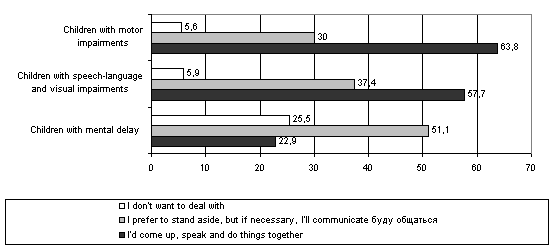
Figure 5. What about your communication with disabled
children? (N=289)
With the help of our research we clarified the high
school students attitudes toward inclusive education of disabled children, who
have difficulties in movements, hearing, speech or vision, mental delay. The
research shows gender differences in correlation between the attitude towards
disabled. Girls notice the children with disabilities more often, and they show
positive attitude: including the attitude towards studying together and communicating.
We have checked different factors of tolerance, including age, gender, social
economic status of the family, type of impairment, and experience. It turned out that the character of this
attitude depends on several factors, the most significant is the experience of
contacts with the disabled in everyday life. The essential differences in the
opinion is between those who haven’t seen the disabled in the street, and those
who have got relatives or friends with disability. About 35% of children, who
have the experience of contacts with disabled persons, are ready to study
together in the same class.
Though there is the
demonstration of intolerance to disability, the majority of respondents are
sure in the necessity to undertake special measures for equality (85%). Just as
the answers point to the self experience of contacts with disabled. More than a
half of respondents consider that there is a need to assist in perceiving them
without prejudice, approximately 40% are sure that it’s necessary to help the
disabled children to live and work without limitation in their movements –
sound traffic lights, ramps for wheelchairs, facilities in public places and
transport.
Interviews with the officials of the Department of Education and school
administration
The officials and administrators in principle support
integration but excluding children with mental delay from the inclusion
policies. They stress the necessity to remain special education for children
with severe disabilities and for the orphans. The main difficulties of
transition to inclusion according to the interviewed are as follows:
1) Lack of legislative base for
implementation of inclusive education
2) Inadequate financial base of
educational system, which prevents proper staffing and technical development of
the program
School administrators and officials of the department
of education believe that children with motor impairments to be integrated at
the first place – who can “normally” keep up with the curriculum, however, they
think that those in wheel-chairs will not be capable to follow up as they are limited
in mobility. To introduce inclusion, according to the experts, it needs to
increase state budget for overall educational system and to raise non-state
funds
Case study at a regular school
In several states of Eastern Europe the policy towards
integration of children with special needs into the mainstream schools has been
successful (Education for All 1998), while in the others such a strategy nor is
has recognised yet as a feature of democracy, neither the economic effects of
integration have been studied. The
research of inside world of special school may not just provide educators and
policy makers with critical assessment of segregated school system. It may help
better understand special educational needs of the students if an official
policy of integration is to take place. Nowadays there are a few students with
motor disabilities in Russian mainstream schools, however, the research is
demanded in such cases of inclusion. Such research could be stimulating tools
for teachers as well as for students with and without disabilities in
developing effective strategies of learning and positive communication (see for
example Kershner and Chaplain 2001).
In Russia there are several preschool and school
settings mainly in Moscow and in some other regions. Some of them are
developing as pilot projects with the support of Soros foundation. However, our
hypothesis is that as a rule children with disabilities who have the privilege
to study at regular schools, are enrolled in a typical school settings that are
not adjusted to special conditions of inclusive environment and the principles
of inclusion are not recognised by the staff.
A longitudinal case study was conducted at
a regular school where a girl Masha with slightly visible motor impairment
(caused by cerebral palsy) was enrolled. She has previously studied for one
year at a residential school for motor impaired children and her mother was
dissatisfied with the level of academic success her daughter could achieve due
to a very relaxed educational program at a special school. After a year, the
mother decided to bring her child to a school, which was located at the nearest
distance from their home. A girl, whose documents contained a medical record
prescribing her to study at a special institution,[1] failed the entering test. In spite of all
efforts the mother received only the following explanation: “she has a narrow
worldview”. At the private meeting the school principle told the mother: “I do
not want your child at my school because this school is a very good one and is
often visited by the Governor. What if he would see a cripple here?”
The mother decided to change the tactics
and falsified the documents with the help of her friend MD. Now the girl did
not have such a prescription that prevented her from entering a regular school.
In the same year, the mother took her to another school, which was far away
from their home but was also a good one. Although without a record but with
visible impairment, a girl receives special attention at the entering test:
An entering test (8yrs):
-Let’s see, you know all the means of transportation
except for one.
-There is not any other.
- Yes, it is
an airplane.
-But my mom does not like airplanes!
With this only “bad” answer the girl receives a permission to become a
student of first grade this school. Naturally, the mother keeps in secret that
Masha has already finished the first grade in a school for the disabled.
In 2001 we have filmed this case and made a TV program on the problems
and perspectives of inclusive education. The mother, the child, the class tutor
and the principle were in support of each other and of the situation itself.
Masha has played with other children in her class, she was considered as a good
student. Two years later the situation changed. The rigidity and selective
approach in organization of primary education, lack of teachers’ reflectivity
and of professional advise and support, huge workload of the teachers and big
sizes of the classes lessened the chances of inclusion. A class tutor in the interview told us about
the difficulties of teaching this child. She has focused not just on her own
incapacities to cope but rather on the behavior or intellectual development of
Masha, which she classified as abnormal. As an illustration, she has explained
us why we did not see Masha’s drawing among the other children’s works at the
exhibition on a wall in school corridor:
Drawing an illustration for a fable (10 yrs):
“Her drawing will be removed from exposition. She
should’ve focused on a crow instead of a pine-tree!..”
Such
situation when the child and the teacher are left without any supervision and
without adequate resources to fulfill educational goals, leads to abuses of
power and practices of semi-corruption:
•Mother: Our class tutor told me: “Not only your
daughter. We have a few students with low scores. I am going to expel them from
the class. Administration said me, it is up to me. You see?”
•Interviewer: So what do you think, she meant?
•Mother: Well, I am glad the 8th March is very soon,
so we’re gonna settle this down for a while.
After
two weeks of making observations, collecting interviews and participating in
classes, we have been rejected by the school principle to continue our work.
She referred to a class tutor who should be paid some bonus for the trouble we
make by sitting in the class (a graduate student was present at the classes and
no teacher complained or rejected her
to participate). Our offer to compensate the trouble to the class tutor
was received with anger and we had to leave the field. Right now we achieved an
agreement in a City Committee for education to conduct case studies at several
schools in Saratov. We hope to come back to this school, too.
Policy implications
The politics of special education for children
with disabilities marginalize children and limits their social orientations and
perspectives. The latent goal of this system is to form such individuals which
can survive on everyday base, who can cope with daily needs. The liberal
democratic vision of education as the vehicle for individual development and
greater social equality does not correspond with separate school system which
develop a problem of educational inequality. The individuals who are recipients
of education cannot be identified as the source of the problem, rather, the
special education system itself demonstrates its inadequacy with the notion of
human rights. The opinion of the key actors of the educational system –
teachers, parents and children – is favorable towards the idea of inclusion as
a project. At the same time, when it comes to a real life situation, a very
practical concern arises, that hinders the true inclusion of the child. The
most important concern is that the system of education remains unchangeable
when it integrates a child with special needs who succeeds in graduating a
regular school only due to enormous energy to be spent by parents and teachers.
This often leads to burnout effects, to abuses of power and to withdrawal of
the child from the regular school setting.
Principal criticisms of current practice of education
1) The part of teachers don't expect the special-ed
children to succeed, and unwittingly fulfill their own prophecy.
2) Regular classroom teachers are willing to refer
even slightly problematic learners to special education (and out of their
classrooms).
3) There is a stigma associated with being placed in
special education that damages a student's self-esteem. Undesirable in itself,
this also interferes with learning.
4) Handicapped and non-handicapped children are
unexposed to each other. A divided school experience makes each group more
ready to accept discrimination against the handicapped in the future.
5) No special conditions are created for the
integrated class, neither special training nor support staff is provided, which
makes the teachers feel unsupported and overwhelmed, blaming the victim which
is the child and the family (predominantly the mother)
How to overcome exclusion within the inclusive
settings
Appeal processes must be developed that allow teachers
to challenge the rightness of inclusive education placements that they
determine to be inappropriate for a child.
At the same time, supervision and independent
expertise should be available to avoid teachers’ collaboration and discrimination
against the child and parents.
Successful inclusion practices depend on restructured
schools that allow for flexible learning environments, with flexible curricula
and instruction.
Sufficient support staff, helping professionals should be employed to
address the social, emotional, and cognitive needs of all students.
Reduce class sizes and/or increase numbers of teachers in the classroom
are necessary
Advantages of inclusive education
1) A reduced fear of human differences accompanied by
increased comfort and awareness
2) Growth in social cognition
3) Improvement in self-concept of non-disabled
students. Development of personal principles and ability to assume an advocacy
role toward their peers and friends with disabilities
4) Warm and caring friendships
5)
Although inclusive education seems likely to improve children's social
development more than their academic achievement, the employment rate for high
school graduates with special needs who had been in segregated programs is
lower than for special needs graduates from integrated programs.
6) Integrated programs are more cost-effective
than the traditional ones.
Recommendations for transition
1. The entire school
community should be involved in a thoughtful, carefully researched transition.
2. Top-down mandated
full inclusion is inappropriate, such directives will polarize parents and
teachers and will create environments that are hostile to any change.
3. Before any new
programs are developed, the staff must agree on a clearly articulated
philosophy of education (an education ethic).
4. Teachers and support staff must be fully
involved in the decision-making, planning and evaluation processes; involve
parents and students as partners in the decision-making process.
5. Teachers, parents,
students and wider society should come to an agreement that diversity is not just a reality to be tolerated, accepted, and
accommodated – it is a reality to be valued
Perspectives for policy analysis and implementation
- We have started an
essay writing competition among the school and university students “From
tolerance towards cooperation. Disability, Society and Me”
- An ongoing research
project “Access to higher education for people with disabilities” is being
conducted under the support of Ford Foundation.
- Educational policy
analysis and advise is provided by a newly established Center for Social
Policy and Gender Studies in Saratov
- A collection of papers
“Inclusive Education: Problems and Perspectives” and/or a thematic issue
of a newly established Journal of Social Policy Studies is to be published
within a few months.
- Conferences and
seminars with school teachers and officials of education are organized.
One of such conferences has recently taken place – a
Conference “Education for All: Ways to Integration” 9-10 January, 2003 Saratov,
Russia. At this conference different stakeholders of special/inclusive
education have been present, in that number, adults with disabilities, teachers
of a special residential school, parents of disabled children, representatives
of the Ministry of Education and Ministry of Labor and Social Development. Some
of the recommendations that come out of this conference and are in concert with
contemporary research on inclusion, are as follows:
•Early intervention
to identify appropriate services for a child
•Individualized
decisions to include any handicapped student in regular education.
• Work toward unifying the special education and
regular education systems. There should be one system for evaluation of special
and regular educational systems
•Real inclusion
involves restructuring of a school's entire program and requires constant
assessment of practices and results.
•A restructured
system that merges special and regular education must also employ practices
that focus on high expectations for all and rejects the prescriptive teaching,
remedial approach that leads to lower achievement.
While planning policy measures for social integration,
the wider context of inclusion has to be taken into account: with regards to family issues,
employment opportunities, availability of natural supportive networks such as
circle of relatives, friends and neighbors, networks of professional helpers.
Mass media have a fuzzy position in regards to social inclusion, as the
predominant image of the disabled person is associated with weakness and
miserability. A very important obstacle is unadjusted physical environment,
while the level of tolerance in the society seems to be
quite high.
References
Aitov N. Social
aspects of getting education in USSR, in: Social research. Issue 2. Moscow:
Nauka, 1968: 187-196
Ashline
N.F., Pezzullo T.R., Norris C.I. (eds) Education, Inequality, & National
Policy. Lexington, MA, 1976
Bart
D. S. The Differential Diagnosis of Special Education: Managing Social Pathology
as Individual Disability. In: Special Education and Social Interests. London, 1984. P. 109-111
Bassey
M. Case study research in educational settings. Buckingham, PA: Open University
Press, 1999
Bernstein
B. Class, Codes and Control. London, 1975; Tough J. Listening to Children
Talking. London, 1976.
Bloom B.S. All Our
Children Learning: A Primer for Parents, Teachers and Other Educators. New
York: McGraw-Hill, 1981.
Bourdieu P. and Passeron J.-C. Reproduction in Education, Society and
Culture. Translated from French by Nice R. London: Sage, 1977.
Breme J. A matrix for
modern education. Toronto, Canad: McClelland&Stewart, 1975.
Bronfenbrenner U. The
ecology of human development. Cambridge, MA: Harvard University, 1979.
Brown
M., Madge N. Despite the Welfare State. London: Heinemann Educational Books,
1982.
Coleman
J.S. et al. Equality of Educational Opportunity. Washington, 1966.
Daniels
H., Garner P. (eds) Inclusive education. Supporting Inclusion in Educational
Systems. London, UK and Sterling, VA USA: Kogan Page, 2000.
Davis
K., Moore W.E. Some principles of stratification, in: Bendix R., Lipset S.M.
Class, Status and Power. New York, 1966.
Deno E. Special
education as developmental capital, in: Exceptional Children. № 54 (2), 1970.
P.229-237.
Dyson A. Inclusion
and inclusions: theories and discourses in inclusive education // Harry Daniels
Philip Garner (Eds.) Inclusive education. Supporting inclusion in education
systems. London, Sterling: Kogan Page, 1999. P.36-53.
Education for
All? Regional monitoring report.
UNICEF. Florence. №5, 1998.
Federal
Law of 20 July 2000, №102-FZ “Concerning changes and addition to the bill 16 of
RF Law “About Education”.
Ferguson D.L., Meyer
G., Jeanchild L., Juniper L., &
Zingo J. (1992) Figuring out what to do with groupings: How teachers make
inclusion “work” for students with disabilities // Journal of the Association
for Persons with Severe Handicaps. №17, 1992. P.218-226.
Giarelli J.M. Qualitiative Inquiry in Philosophy and
Education: Notes on the Pragmatic Tradition, in Qualitative Research in
Education: Focus and Methods. Ed. By Sherman R.R., Webb R.B. London, New York,
Philadelphia. The Falmer Press, 1990. p.22-27.
Goffman
E. Stigma. Notes on the Management of Spoiled Identity. New York, London: A
Touchstone Book, 1986.
Gromova
O. Educational segregation, in: Russian Journal 23 August 2001.
www.russ.ru/ist_sovr/sumerki/20010823_grom.html
Hall R.M., Sandler B.R. The classroom climate: a
chilly one for women? Washington, DC: Association of American Colleges, Project
on the Status and Education of Women, 1982.
Higher education – for disabled people
http://www.deaflife.ru/6ved5.html
Higher
Education in Russia. №1, 1996.P.3-36; Federal Law of 22 August 1996 №125-FZ
“Concerning higher and postgraduate professional education”.
Hurst L. Mr.Henry makes a Deal: Negotiated
Teaching in a Junior High School, in: Burawoy et al. Ethnography Unbound. Power
and Resistance in the Modern Metropolis. Berkeley, Los Angeles, London:
University of California Press, 1991. P.183-202.
Iarskaia
E.R., Loshakova I.I. Integration in the conditions of differentiation: problems
of inclusive education for atypical children. Saratov: Pedagogic Institute SSU,
2002.
Iensen
A. How much can we boost IQ and scholastic achievement? In: Harward Educational
Review, 29, 1967; Iensen A. Bias in Mental Testing. New York, 1979.
Ikonnikova S. Youth:
sociological and social-psychological analysis. Leningrad: LGU, 1974
Illich
I.D. Deschooling Society. Harmondsworth, 1973; Willis P. Learning to Labour:
How working kids get working class jobs. London, 1977.
Jenkins
D. Widening Participation – a case study from Staffordshire University, in:
Social Inequality and Education: problems, research, actions. International
seminar materials. Saratov: SSTU, 2001. P.80-87.
Jenks
C. et al. Inequality: A Reassessment of the Effects of Family and School in
America. New York, 1972; Persell C.H.
Education & Inequality: the Roots and Results of Stratification in
America's Schools. New York: Free Press, 1979.
Kershner R. and
Chaplain R. Understanding Special Educational Needs. A Teacher’s Guide to
Effective School-based Research. London: David Fulton Publishers, 2001.
Konstantinivski D.
Dynamics of inequality. Russian youth in a changing society: orientations and
ways in spheare of education (from 1960s to 2000). Edited by V.Shubkin. Moscow:
Editorial URSS, 1999.
Lawrence-Brown,
Diana. Should I/Can I?: A Framework for Understanding Educators Comfort or
Concerns with Inclusion http://www.indiana.edu/~sersig/Lawrence-Brown_02.htm
Lipsky D.K., Gartner
A. Achieving full inclusion: Placing the student at the center of educational
reform, in: W.Stainback &
S.Stainback (Eds.) Controversial issues confronting special education:
Divergent perspectives. Boston: Allyn & Bacon, 1991. P.3-13.
Materials
for State Board Meeting of RF 29.08.2001. M.:UNIKUM-CENTR, 2001. P.10.
McIntosh P. An Archi-texture of Learning
Disability Services: the use of Michel Foucault, in: Disability and Society.
Vol, 17, No.1, 2002. pp.65-79.
Mercer J.R. The
meaning of mental retardation, in: R.Koch & J.C.Dobson (Eds.) The mentally
retarded child and family. NY: Brunner/Mazel, 1971.
Modernization
of Russian educational system and social aspects of budget project RF to 2002 year. Interview with V.I. Matvienko
http://www.ege.ru/strana_01.html
Oliver M. and Barnes
C. Disabled People and Social Policy. From Exclusion to Inclusion. London and
New York: Longman, 1998
Oliver M. The
Politics of Disability. London: Macmillan, 1990
Peck, C .A., Carlson, P., and Helmstetter, E.
Parent and Teacher Perceptions of Outcomes for Typically Developing Children
Enrolled in Integrated Early Childhood Programs: A Statewide Survey in: Journal of Early Intervention, 1992:
53-63.
Pinnel G.S. &
Galloway C.M. Human development, language and communication: Then and now, in:
Theory into Practice. №26, 1987. P.353-357.
Review of the
National Educational Policy. Higher education and research in Russian
Federation. Moscow: Ves Mir, 2000.
Reynolds M. A
framework for considering some issues in special education, in: Exceptional
children. №28, 1962. P.367-370.
Reynolds M. An
historical perspective: The delivery of special education to mildly disabled
and at risk students, in: Remedial and special education. №10 (6). P.7-11.
Robertson
D. & Hillman J. Widening
Participation in higher education for students from lower socio-economic groups
and students with disabilities, Report 6 for the National Committee of Inquiry
into Higher Education. www.leeds.ac.uk/educol/niche/ report6. htm Обращение к
ресурсу февраль 2000г.
Robertson
D. and Hillman J. Widening Participation in higher education for students from
lower socio-economic groups and students with disabilities, Report 6 for the
National Committee of Inquiry into Higher Education.
www.leeds.ac.uk/educol/niche/report6.htm
Salisbury C.L.,
Palombaro M.M., Hollowood W.M. On the nature and change of an inclusive
elementary school, in:The Journal of the Association for Persons with Severe
Handicaps. № 18, 1993. P.75-84.
Shea T.M., Bauer A.M.
An Introduction to special Education. A Social systems perspective. 2nd
edition. Madison, WI: Brown & Benchmark, 1997
Shevlin M., Kenny M. & McNeela E.
Curriculum Access for Pupils with Disabilities: an Irish experience, in:
Disability and Society. Vp.17, No.2, 2002. pp.159-169.
Shubkin
V. et al., Experience of using quantitative methods in concrete sociological
research. Novosibirsk: Novosibirsk State University, 1964.
Stout, Katie
Schultz, Special Education Inclusion. WEAC Education Issues Series
http://www.weac.org/resource/june96/speced.htm Posted November 5, 2001
Stubbs M. Language, Schools and Classrooms. London:
Willey, 1976.
Titma
M. Choice of an occupation as a social problem. Moscow: Mysl, 1975.
Whitston
K. Widening Participation: education, equality and the economy, in: Social
Inequality and Education: problems, research, actions. International seminar
materials. Saratov: SSTU, 2001. P.13-27
Whitston K. Widening
Participation: education, equality and the economy, in: Social inequality and
education: problem, research, action. Saratov: SSTU, 2001: 13-27.
Will M.C. Educating
children with learning problems: A chared responsibility // Exceptional
Children. №52, 1986. P.411-415.
Wood J.T. Gendered
Lives. Communication, Gender, and Culture. Belmont, CA: Wadsworth Publishing
Company, 1994.